
Best practices and case study
Theory provides guidance — but true confidence comes only when real-world experiences become apparent. Companies that successfully use exoskeletons demonstrate how integration can be achieved and what positive effects result.
Every work environment has its own unique requirements. The following case studies illustrate how companies and organizations have approached implementation, what experiences employees have had in their day-to-day work, and which factors were crucial for a successful rollout. They demonstrate that there is no one-size-fits-all solution; instead, each case must be considered individually.
Nursing home "Haus am Park"
Anna, the nursing director, sits at her desk staring at the internal documents. She had actually planned to test the exoskeleton with her colleagues, but no one knows who is authorized to approve the budget: Purchasing, management, or herself? The uncertainty is paralyzing the planning process.
Yet the need for the exoskeleton is obvious: every shift involves heavy lifting, overextending, and constant bending for the team — and back problems are the order of the day. Without clear decision-making channels, the added value remains hidden, and the employees feel no relief.
Anna decides to bring all the decision-makers together for a brief meeting. She clearly outlines the benefits: less strain on the back, reduced absenteeism, and more energy for patient care. Within a week, the pilot is approved. After just the first few shifts, the employees report enthusiastically: “It’s much easier to move patients — my back feels relieved.”
Hospital "Lebensbrücke"
The caregivers are skeptical: “Yet another new device we’re supposed to try out.” Some find it stigmatizing: “It looks like I’m sick.” Besides, no one is quite sure how or when it should be used.
Management responds sensitively: During the pilot program’s introduction, the team is allowed to try out the exoskeletons, and all questions are answered. After two weeks, employees are wearing the device voluntarily — because they feel that it truly relieves their strain. The psychological barrier falls, motivation and acceptance rise, and the back is protected in the long term.
Nursing Home "Kastanie"
At Haus Kastanie, a nursing facility in a medium-sized town, Ms. Schneider, the nursing director, began to notice the increasing physical strain on her team. Time and again, staff members reported back pain after long shifts, and Ms. Schneider knew: “We can’t go on like this; we have to do something.”
One day, she first heard about exoskeletons at a trade show. The term stuck with her, and she began to research the topic in depth. It quickly became clear: these devices could specifically reduce back strain without limiting her employees’ work.
Ms. Schneider contacted the consulting team for her preferred exoskeleton and scheduled a detailed consultation. Together, they analyzed usage scenarios, reviewed workflows, and drew up a plan for a pilot phase. It was decided to first pilot a passive exoskeleton for the back — ideal for the regular lifting and carrying tasks in everyday nursing care.
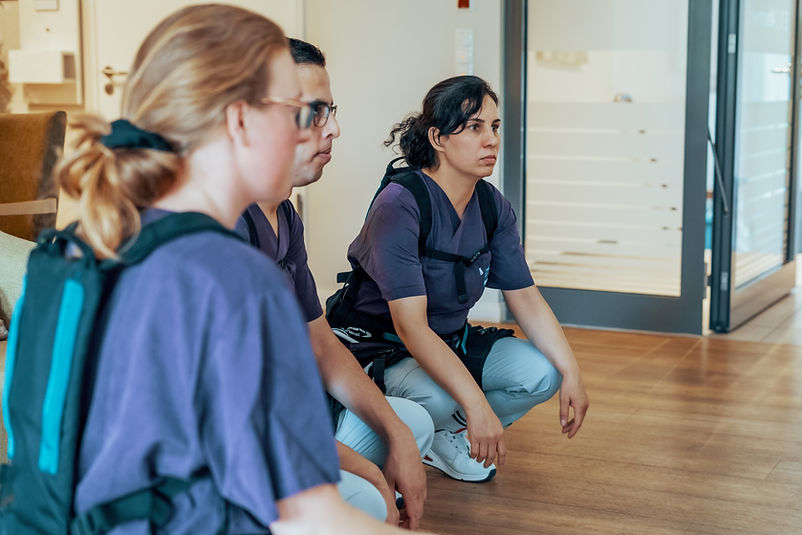
The rollout began with training sessions for the staff: brief, practical briefings tailored to their individual work areas. At first, some were skeptical. “Yet another new tool… will this even help?” Ms. Schneider heard. But after just a few days of use, the nursing staff reported a noticeable reduction in back pain, a more comfortable physical sensation, and more energy at the end of their shifts.
The pilot phase was carefully documented: perceived strain, back pain, observations of ergonomic effects — all data showed positive results. Based on this, the decision was made to permanently purchase the exoskeletons for all employees. Today, the devices are an integral part of daily life at Haus Kastanie and have helped the team work in a way that is easier on the back, ensuring employees stay healthy in the long term.